


Friction springs
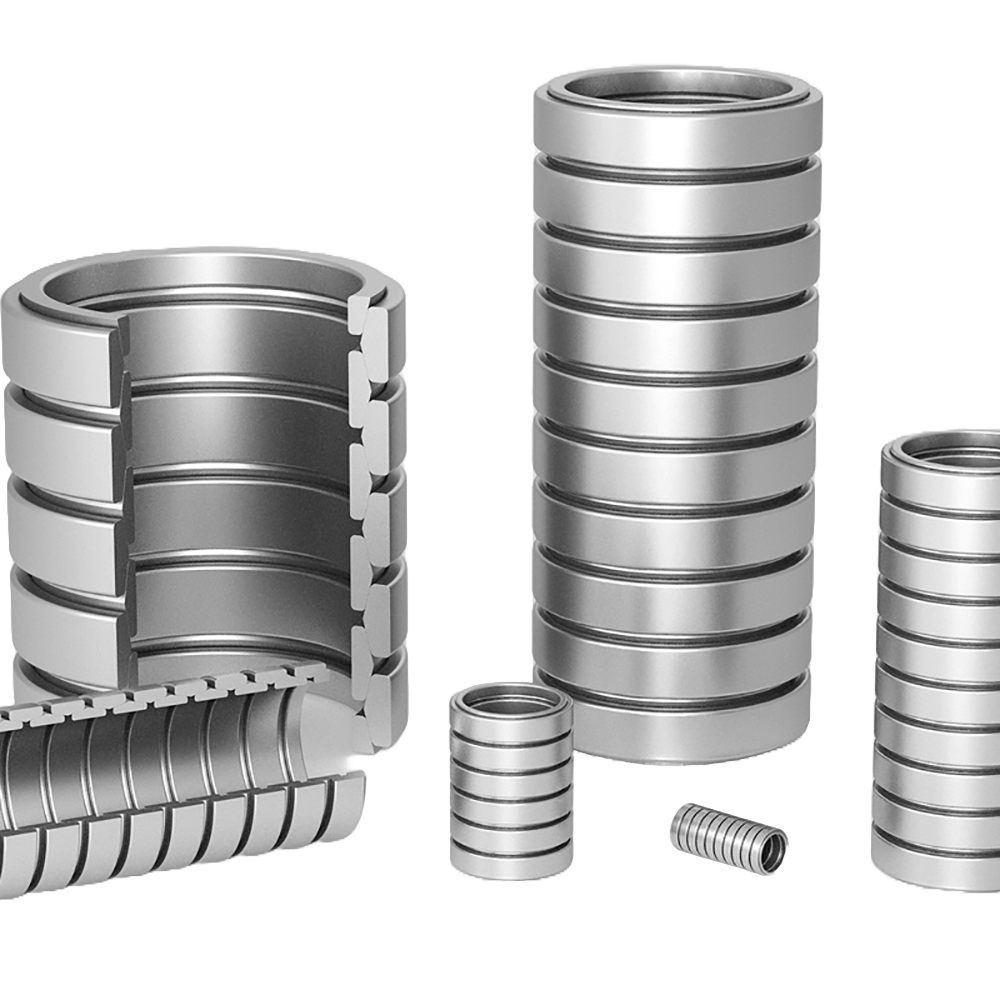
Friction springs
Download PDF
Slowing down moving masses in a quick, safe, and precise manner: Friction springs are indispensable, maintenance-free safety components. They are used across all technology and industry sectors where sudden forces need to be absorbed, kinetic energies must be dissipated, or damping systems are required. These springs handle enormous forces within relatively small dimensions. They consist of precisely machined outer and inner rings, assembled into complete spring columns according to the user's specific requirements. Each unit is 100% tested and subjected to multiple load cycles before delivery, ensuring absolute functional reliability.
Friction springs offer several advantages compared to conventional damping solutions:
- High spring work at low weight and volume: By fully utilizing the spring material, the dimensions and weight of friction springs are minimized. The key factor here is the spring work.
- High damping capability: The standard damping rate for these friction springs is 66%, meaning that introduced energy is quickly absorbed and resonance effects are completely suppressed. Damping variations between 33% and 66% can be achieved by using specific lubricants tailored to the customer and application.
- Consistent spring work and damping effect regardless of load speed: The force-stroke diagram of friction springs applies under all operating conditions. Unlike other damping systems, friction springs maintain full spring work and damping effect even with extremely slow or rapid load application.
- Overload protection in block position: Friction springs are generally designed to "block," ensuring that permissible stresses are not exceeded and the springs remain undamaged.
- Temperature independence: Unlike hydraulic dampers or synthetic springs, whose force-stroke diagram can be affected by temperature fluctuations and internal heating, the characteristic curve of friction springs remains constant within a temperature range of -20 °C to +60 °C. However, self-heating due to damping must be considered. For applications outside this temperature range, please consult our experts.
- Parallel and serial arrangement of springs: To better utilize existing installation space, friction springs can be arranged in two different manners: parallel for higher forces, or serial for more spring travel.
- Custom designs for specific applications: In addition to standard friction springs, customized solutions can be provided to meet the needs of specific applications.